The editor is built on a 4-dimensionalism modelling approach where every element is a chunk of space and time. Understanding the following concepts is essential for interpreting the diagram's layout and accurately mapping your data to the visual canvas.
Below is a reference guide to the core terms used throughout the editor.
Back to User Guide
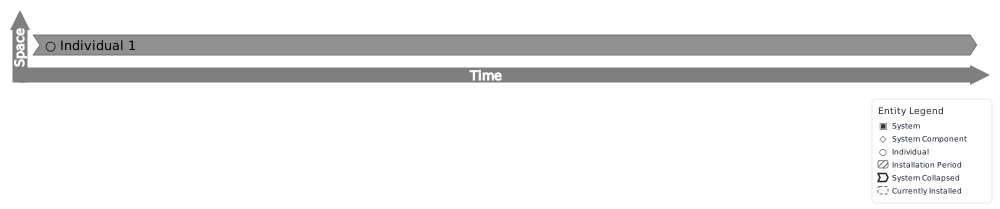
- Individual
- Something that persists through space and time, such as a person, a piece of equipment, an organisation, or a document. On the diagram each individual is drawn as a horizontal band running left to right for the duration of its existence.
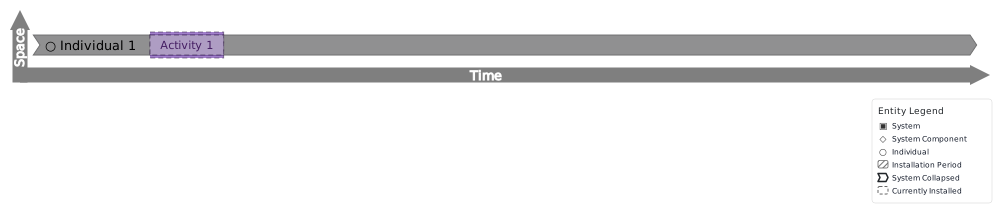
- Activity
- A bounded period during which entities come together to achieve something. On the diagram an activity is rendered as an outline rectangle spanning the time window and the participating entity rows.
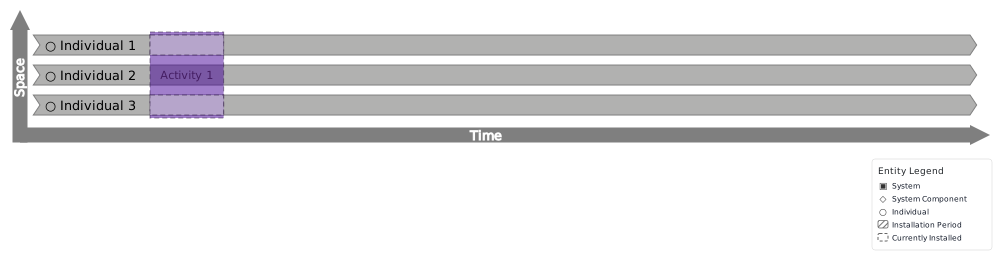
- Participation
- The link between an entity and an activity for a defined period. On the diagram a participation is shown as a filled block at the intersection of the entity's row and the activity's time span.
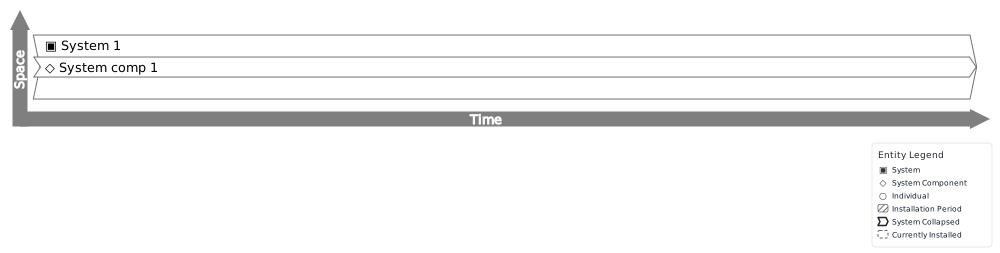
- System
- A structured assembly of system components. A system is drawn as a large outline rectangle whose interior contains its entities.

- System Component
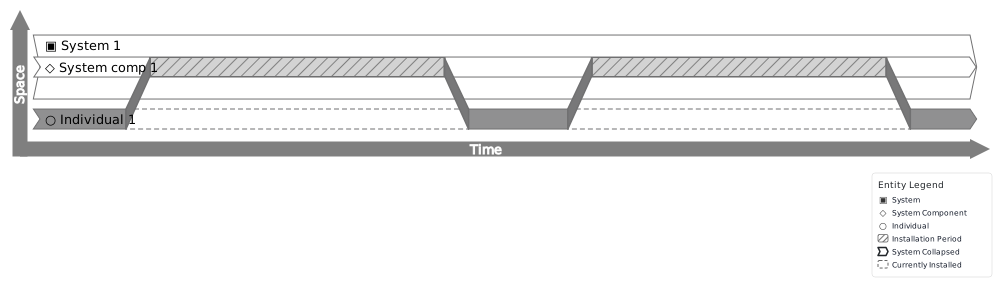
- A persistent role or slot within a system. It represents a named position that may be filled by different individuals over time; the role persists even when temporarily unfilled. A system component is a component of its parent system.
- Installation
- The fusion of an individual with a system-component slot for a specific time range. Installations allow the same slot to be occupied by different individuals at different times.
- State
- A qualitative property of an entity that changes over time (e.g. Open/Closed, Running/Stopped). States are rendered as distinctly shaded segments within an entity's band.
- Event
- An entity with minimal or zero temporal extent, representing an instantaneous or near-instantaneous occurrence rather than a persisting state.
- Temporal Boundaries
- Every entity has a beginning and an ending. A flat vertical edge means the bound is known; an open chevron means it is unknown. Both ends are set independently.
- Space Axis (Y-Axis)
- The vertical axis of the diagram. It does not represent physical location; it gives visual room to distinct entities. Vertical nesting encodes part-whole relationships: if A is part of B, A's band sits within B's extent on the diagram.
- Time Axis (X-Axis)
- The horizontal axis, always running left to right in temporal sequence. It can be linear (uniform scale) or non-linear (compressed/stretched regions) depending on what needs emphasis.